IT 244: Introduction to Linux/Unix
Class 20
Tips and Examples
Review
New Material
Microphone
Questions
Are there any questions before I begin?
Homework 9
I have posted Homework 9 here.
As usual, it will be due next Sunday at 11:59 PM.
Quiz 7
I have posted the answers to Quiz 7
here.
Today's Class
Today we will cover a number of topics including
the history mechanism, the readline library, aliases and functions.
Tips and Examples
Seeing All Running Processes
- By default,
ps only shows you the processes running in your current shell
- It will not show processes running in another terminal session ...
- connected to the same machine
- To see process running on all your sssh sessions ...
- run
ps -u
- If you follow this with a username it will show all processes for that user
- So if you wanted to see all processes run by root you would type
ps -u root
ps -aux will show all running processes
Review
Positional and Special Parameters
- Positional and special parameters are special variables set by Unix
- All these variables have names which are a single character
- Their values change each time you run a command
- We can see their values ...
- but cannot change them
- We have already encountered the special parameter ?
- It contains the status code returned by the last command
- Positional parameters
are used by shell scripts
- Positional parameters let a shell script get the values it needs ...
- from the command line arguments
- Each string on the command line is assigned to a positional parameter
- The first token on the command line is assigned to positional parameter 0
- This parameter contains the
pathname
used to run the script
- Each additional token on the command line ...
- is assigned to the next positional parameter
$ cat print_positionals.sh
#!/bin/bash
#
# Prints the value of the first four positional arguments

echo
echo 0: $0
echo 1: $1
echo 2: $2
echo 3: $3

$ ./print_positionals.sh foo bar bletch
0: ./print_positionals.sh
1: foo
2: bar
3: bletch
- Positional parameters are the usual way input is given to a script
- Another special parameter is #
- # contains the number of command line arguments
$ cat print_arg_numbers.sh
#!/bin/bash
#
# Prints the number of arguments sent to this script

echo
echo This script received $# arguments

$ ./print_arg_numbers.sh foo bar bletch
This script received 3 arguments
Quoting and the Evaluation of Variables
- You have to be careful when giving a variable a value containing
whitespace
$ name=Glenn Hoffman
Hoffman: command not found
- Linux will not allow a variable's value to contain one of the whitespace
characters
- There are three things you can do to handle whitespace
- Use single quotes (' ')
- Used ouble quotes (" ")
- Use a backslash (\)
- Single quotes are the most restrictive
- Ever character surrounded by single quotes appears in the value ...
- exactly as you entered it
- So special characters like $ lose their
special meaning ...
- inside single quotes
$ team="Red Sox"

echo $team
Red Sox

$ cheer='Go $team'

$ echo $cheer
Go $team
- If you want special character to work, use double quotes
$ cheer="Go $team"

$ echo $cheer
Go Red Sox
- Quotes affect everything they enclose
- The backslash, \ ,
only effects the character immediately following it
Processes
- A
process
is a running program
- Processes have resouces that they need to do thier work
- Among these resources are
- An area in RAM
- Time on the CPU
- Connections to the 3 standard data streams
- Unix is a multitasking operating system
- That means many processes can run at the same time
- The shell runs in a process like any other program
- Every time you run a program, a process is created ...
- except when you run a
builtin
...
- because builtins run in the same process as your current shell
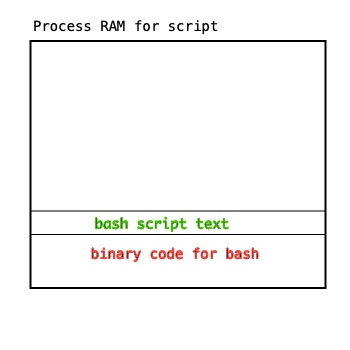
- To run a shell script a process is created
- Into this process is loaded the text of the script ...
- and the binary code for Bash
- The picture in memory looks like this
Process Structure
- Processes are created in a hierarchical fashion
- When the machine is started, there is only one process
- This process is either
init or systemd
- Which one depends on what flavor of Linux you are using
- This process then creates all the other processes needed
- Different services, such as a web server, each need their own process
- These new processes are child process of the first process
- These child processes can create other processes
init or systemd has PID (Process ID) of 1 ...- and is the ancestor of every other processes on the machine
Process Identification
Executing a Command
- The shell is a program that lets you run commands
- Each time you run a command ...
- except a builtin ...
- the shell has to ask the kernel to create a process
- Then the shell sleeps ...
- waiting for the child process to finish
- When the child process finishes ...
- it returns an exit status to the shell
- The shell wakes from it's sleep when it gets the exit status
- It is now ready for your next command
- When you run a command in the background ...
- the shell does not go to sleep
- So it is ready to run another command
- Child process inherit all the
global variables
...
- of the parent process
Attendance
New Material
History
- If you hit ↑, the shell will bring back your last command
- When you do this, you are using Bash's history mechanism
- The history mechanism maintains a list of the command lines you have run
- These command line entries are called
events
- Keep hitting ↑ to go back in time to previous commands
- If you go too far, hit ↓ to go forward in time
- The history list also serves as a record of what you have done
- If a command does not work ...
- you can use the history mechanism to see what you did wrong ...
- and fix it with command line editing
- To view the history list, use the
history command
$ history
    2  exit
    3  cd
    4  cd it244/work
    5  pwd
    6  rm -rf *
    7  cd ~/it244/work
    8  pwd
    9  cp ~ghoffman/examples_it244/bother.sh .
   10  ls /home/ghoffman/examples_it244
   11  cp ~ghoffman/examples_it244/bother.sh .
   12  ./bother.sh
   13  ./bother.sh &
   14  jobs
   ....
- Running
history without an argument shows the entire list
- By default, the list contains 500 values ...
- which is probably more than you want to see
- To show a smaller number of events ...
- run
history followed by a number
$ history 10
  498  ps
  499  exit
  500  exit
  501  history
  502  cd
  503  cd it244
  504  cd work
  505  ls
  506  history
  507  history 10
- Notice that there is no - in front of the
argument to
history ...
- unlike with
head or tail
Variables that Control the History Mechanism
Using the History Mechanism
- You can use the history list without using the
↑
and ↓ keys
- Using the arrow keys to get back a very old command ...
- would be very annoying
- You would have to hit ↑ many times ..
- to get the right event
- But the history mechanism provides an easier way ...
- if you know the event number ...
- which you can get by running
history
$ history 5
  515  cd ~ghoffman/examples_it244/
  516  pwd
  517  echo $PATH
  518  cd
  519  history 5
- You can run a previous command again ...
- with an exclamation mark,
! ...
- followed by the event number
$ !517
echo $PATH
/usr/local/sbin:/usr/local/bin:/usr/sbin:/usr/bin:/sbin:/bin:/usr/games
- When you do this the history mechanism ...
- prints out the old command line ...
- before running it
- There must be no space between the ! and the number
- If there is you will get an error message
$ ! 517
517: command not found
- You can follow ! with a letter ...
- which will run the last command beginning with that letter
$ !e
echo $PATH
/usr/local/sbin:/usr/local/bin:/usr/sbin:/usr/bin:/sbin:/bin:/usr/games
Using fc to Edit and Run an Old Command
- The utility
fc (fix command) allows you
to edit a previous command line ...
- and then run it
fc is a builtin so it executes quickly- When run with no arguments ...
fc will open up an editor window ... - holding the last command
- You can then
- Modify the command in the editor window
- Save your changes
- The modified command will be run when you quit
- You can also run
fc with an event number
fc EVENT_NUMBER
- Running
fc this way will put that command in the editor window ...
- where you can change it ...
- and run it
fc can also be used to view the history list- When run with the -l option ...
fc will list the last 16 command lines
$ fc -l
511  ls
512  cd
513  ls
514  history 5
515  cd ~ghoffman/examples_it244/
516  pwd
517  echo $PATH
518  cd
519  history 5
520  echo $PATH
521  ! 517
522  echo $PATH
523  traceroute -a standford.edu
524  echo $PATH
525  echo $PATH
526  echo $PATH
- You can also tell
fc to list all events ...
- starting with a certain number
- You do this by running
fc -l ...
- followed by a space and a number
$ fc -l 522
522  echo $PATH
523  traceroute -a standford.edu
524  echo $PATH
525  echo $PATH
526  echo $PATH
527  fc -l
- You can also have
fc -l list a range of events ...
- by following
fc -l with two numbers
$ fc -l 522 525
522  echo $PATH
523  traceroute -a standford.edu
524  echo $PATH
525  echo $PATH
- If you run
fc -l with two strings ...
- it will list a range of command lines
- The list will start ...
- with the last command line that matches the first string ...
- and end with the last command that matches the last string
$ history 10
  521  ! 517
  522  echo $PATH
  523  traceroute -a standford.edu
  524  echo $PATH
  525  echo $PATH
  526  echo $PATH
  527  fc -l
  528  fc -l 521
  529  fc -l 522 525
  530  history 10

$ fc -l t f
523  traceroute -a standford.edu
524  echo $PATH
525  echo $PATH
526  echo $PATH
527  fc -l
528  fc -l 521
529  fc -l 522 525
- When would you use
fc?
- To modify the last command you would simple hit ↑ ...
- and use command line editing
- But what if you wanted to change a command you ran some time ago?
- In that case you could use
history to get the event
number ...
- then edit the command using
fc and that number
The Readline Library
- The Readline library is a collection of procedures ...
- written in the C programming language
- These procedures are compiled into a binnary file ...
- that can be used by any program written in C
- These procedures give the program that uses them ...
- the ability to edit the command line
- The Readline library was created by the GNU project
- Whenever you do command line editing ...
- you are using the Readline library
- Earlier I said that the device driver tty ...
- provided command line editing
- It's true that it does ...
- but it does this using the Readline library
- Any program running under Bash and written in C ...
- can use the Readline library
- I use it when running SQLite commands ...
- at the SQLite command line
- SQLite can do this because it was written in C
- There are two modes available in the Readline library
- The Readline Library uses emacs mode by default
- That is the mode we have been using in this class
- Here are some of the more useful commands ...
- for the emacs version of the Readline library
| Command | Meaning |
| Control A |
Move to the beginning of the line |
| Control E |
Move to the end of the line |
| Control U |
Remove everything from the text entry point to the
beginning of the line
|
| Control K |
Remove everything from the text entry point to the end
of the line
|
| ← |
Move the text entry point one character to the left |
| → |
Move the text entry point one character to the right |
| ↑ |
Recall the previous command line entry in the history list |
| ↓ |
Recall the following command line entry in the history list |
- If you want to switch to vi mode run the following command
set -o vi
- Add this command to your .bash_profile
...
- and you will always run Bash in vi mode
Readline Completion
- The Readline library provides a completion mechanism
- Type a few letters and hit Tab ...
- and Readline completion will try to supply the rest
- There are three forms of completion provided by the Readline library
- They all use Tab to complete something
- But they differ in what they complete
Pathname Completion
Command Completion
Variable Completion
Aliases
- aliases
give you a shortcut ...
- for running a command
- Instead of typing the command and its options
- You type the name of the alias
- And Bash replaces it with the command ...
- and maybe some options and arguments
- I often want to get a long listing for a directory ...
- and
ls -l is quite a few characters to type
- So I have defined an alias, ll
alias ll='ls -l'
- If I want a long listing I can simply type
ll instead of ls -l
$ ll
total 45
-rwxr-xr-x 1 ghoffman grad     38 Oct 11 20:05 border.sh
-rwxr-xr-x 1 ghoffman grad    135 Oct 16 08:35 bother.sh
-rwxr-xr-x 1 ghoffman grad     13 Oct 29 14:23 cheer.sh
-rwxr-xr-x 1 ghoffman grad    103 Oct  9 08:53 command_name.sh
-rwxr-xr-x 1 ghoffman grad     99 Oct 29 16:15 comment_test.sh
...
- To define an alias, you use the
alias command ...
- with the following format
alias ALIAS_NAME=COMMAND
- There cannot be any spaces on either side of the equal sign, =
- Just like when defining variables
- If the command string has spaces it must be quoted
alias la='ls -a'
- If you run
alias with no arguments ...
- it will list all aliases currently defined
$ alias
alias bin="pu $bin'
alias binl="ls $bin'
alias ck755="ls -l *.sh | tr '\''-'\'' '\'' '\'' | grep '\''rwxr xr x'\'''
alias ckhb="head -1 *.sh | grep  /bin/bash'
alias cl="pu $cl'
alias clhws="pu $clhws'
alias clhwsl="ls $clhws'
alias cll="ls $cl'
alias clr="clear'
...
- To see the value of an alias you have already defined ...
- type
alias with the alias name
$ alias ll
alias ll='ls -l'
- In Bash an alias cannot use positional parameters
- But an alias can in the TC shell
- Although an alias cannot accept command line arguments in Bash ...
- an argument can follow the alias
- This is a subtle point
- I can use my
ll alias and follow it with the name of a directory
- So if I were to type the following on the command line
ll /home/ghoffman
- Bash substitutes
ls -l for ll ...
- and the command becomes
ls -l /home/ghoffman
- But what if I wanted to create an alias for a pipe using two commands ...
- and I needed to pass an argument to the first command?
- For example if I wanted to create an alias for something like this
ls -l DIRECTORY_NAME | head
- In Bash, I cannot create an alias like this
alias llh="ls -l $1 | grep txt"
- Because an alias cannot use positional parameters
- Instead of allowing aliases to accept command line arguments ...
- Bash has functions
- Functions in Bash can consist of many commands ...
- and you can use positional parameters with each of these commands
- We'll discuss functions a little later in this class
- An alias cannot call itself
- And aliases are not global
- They only work in the shell in which they are defined
$alias ll='ls -l'

$ bash

$ ll
ll: command not found
- The
alias command is a builtin
$ type alias
alias is a shell builtin
- Because aliases are always local ...
- the alias command will only work ...
- in the shell in which it is defined
Single Quotes Versus Double Quotes in Aliases
- There are two types of quotes in Bash
- Single quotes - ' '
- Double quotes - " "
- Both single and double quotes allow you to use a string ...
- that contains whitespace ...
- as a value to a variable
$ name="Glenn Hoffman'

$ echo $name
Glenn Hoffman
- The whitespace characters are
- Single quotes turn off all special meanings of characters
$ echo 'My name is $name'
My name is $name
- Variables are not evaluated when they are enclosed in single quotes
- But double quote allow you to use the value of a variable using $
$ echo "My name is $name"
My name is Glenn Hoffman
- Usually, when defining aliases you want to use single quotes
- These quotes prevent variables from being evaluated when the alias is defined
- They force variables inside an alias to be evaluated when they are used
- Which is usually what you want
Examples of Aliases
- I have defined a number of aliases to make my work easier
- One alias makes it easier for me to list the "invisible files" in a directory
$ alias la="ls -a'

$ la
.   .addressbook   .bash_profile  .cshrc  .login   .pinerc
..  .bash_history  .cache         it244   .msgsrc  .ssh
- Another alias makes it easier to see the most recently created files and directories
$ alias ltr
alias ltr="ls -ltr'

$ ltr ~/bin/shell
total 4
-rwxr-xr-x 1 ghoffman grad 107 Oct 13 09:42 border.sh
-rwxr-xr-x 1 ghoffman grad 339 Oct 13 09:42 homework_setup.sh
-rwxr-xr-x 1 ghoffman grad 306 Oct 14 00:18 homework_copy.sh
-rwxr-xr-x 1 ghoffman grad 156 Nov  5 17:09 step.sh
- This alias sorts the long directory listing ...
- with the most recent entries at the bottom
- This make is easier to see the most recently modified files
- I have created global variables for all the directories I visit often
export lncd=/courses/it244/s19/ghoffman
export lntst=/home/ghoffman/code/it244_code/testing_scripts_it244
export lnwb=/home/ghoffman/public_html/it244_html
- Then I create two aliases using each of these variables
- One to go to that directory
alias lncd='pu $lncd'
alias lntst='pu $lntst'
alias lnwb='pu $lnwb'
- And the other to run
ls on the directory
alias lncdl='ls $lncd'
alias lntstl='ls $lntst'
alias lnwbl='ls $lnwb'
pu is a function which I will describe below- I follow a standard procedure when defining such aliases
- First I create a variable holding the absolute address of the directory
- Then I create an alias to go to that directory
- The name of this alias ...
- is the same as the name of the variable
- There is no possibility of confusion since you put $ in front of a variable
- The aliases to list the contents of the directory use the variable name
- Followed by l (el)
- I also use an alias to log into pe15
- Instead of typing
ssh ghoffman@pe15.cs.umb.edu
- I type
pe15
- Here is the definition of pe15
$ alias pe15
alias pe15='ssh ghoffman@pe15.cs.umb.edu'
- All my aliases are defined in a startup file
Functions
- A function
is a collection of shell commands that is given a name ...
- and does something useful
- Functions can accept arguments from the command line ...
- using positional parameters
- A function can be run anywhere in the filesystem ...
- since it has no pathname
- You simply type the name of the function to run it
- Functions differ from shell scripts in a number of ways
- They are stored in memory (RAM), rather than in a file on disk
- The shell executes the function in it's own process
- For these reasons, functions run faster than shell scripts
- All the functions you define are loaded into the memory ...
- of your shell process
- So functions are like shell scripts you define in RAM
- Functions definitions have the following form
FUNCTION_NAME ()
{
    COMMAND
    COMMAND
    ...
}
- Where COMMAND is anything you can enter at the command line
$ whoson ()
> {
>   date
>   finger | grep 'pts/'$1
> }

$ whoson 14
Sun Nov 10 20:18:33 EST 2013
thamerfa  Thamer AlTuwaiyan   pts/14      2  Nov 10 18:44 (c-174-63-86-44.hsd1.ma.comcast.net)
- Once you type the final } the definition is complete ...
- and you get a command prompt back
- You can define a function on a single command line
$ echo3 () { echo $1; echo $1; echo $1;}

$ echo3 foo
foo
foo
foo
- But you must use a semicolon after each command ...
- including the last command
- For clarity, you can precede the function name ...
- with the keyword
function
$ function cheer ()
> {
>   echo Go $1'!'
> }

$ cheer 'Red Sox'
Go Red Sox!
function is not a command
$ type function
function is a shell keyword
- So it is optional when defining a function
- You can pass command line arguments to a function ...
- using the positional parameters
$ print_args ()
> {
>   echo "arg1: $1"
>   echo "arg2: $2"
> }

$ print_args foo bar
arg1: foo
arg2: bar
- To see the definition of a function, you can use the
type command
- I declare the function pu everywhere I work
- I use this in place of
cd
$ type pu
pu is a function
pu ()
{
    echo;
    pushd $1 > /dev/null;
    ls --color=auto
}

$ pwd
/home/it244gh

$ pu ~ghoffman

bin                            issues      omar
bugs                           it114       public_html
code                           it116       stdwrk
course_files                   it116_test  submitted
course_materials               it117       tests_taken
course_scoring_documents       it117_test  tmp
demos                          it244       wrk
flask                          it244_test  xrchiv
html                           mail
hw1_piazza_filename_create.py  messages

$ pwd
/home/ghoffman
- This function first prints a blank line ...
- which makes things easier to read
- Then it calls
pushd
- But
pushd prints the directory stack
- Which I find distracting
- So I send this output to /dev/null
- Next I run
ls so I can see the contents of my new directory
- I chose
pu as the function name because it is shorter
than "push"
- When I call
pu it goes to a new directory ...
- and puts that directory on top of the directory stack
- To return to the previous directory I use
po
- Which is short for
popd
popd takes the current directory off the stack ...- and returns to the previous directory
- But
popd does not require an argument
- So
po is an alias
$ alias po
alias po='popd > /dev/null; echo; ls'
- This alias uses
popd to return to the previous directory
- It redirects the printing of the directory stack to /dev/null
- Then it prints a blank line, and prints the contents of the directory
- To remove a function use the
unset command
$ print_args foo bar
arg1: foo
arg2: bar

[591] (pe15) ghoffman - ~
$ unset print_args

[592] (pe15) ghoffman - ~
$ print_args foo bar
print_args: command not found
- Functions, unlike aliases, can be make global ...
- by calling
export with the -f option
export -f FUNCTION_NAME
- Here is an example
- First I define the function hw
$ type hw
hw is a function
hw ()
{
    echo Hello world!
}
- When I call the function I get
$ hw
Hello world!
- Then I export it
$ export -f hw
- The I create a Bash subshell and call hw
$ bash # create a subshell
ghoffman@pe15:~$ hw # call the function
Hello world!
Where to Define Variables, Aliases and Functions
- Alias are local
- And cannot be used in subshells
- Aliases should be defined in your
.bash_profile
- If I need to use an alias in a script
- I could include the following a the top
source ~/.bash_profile
- Since functions can be made global by using
export -f ...
- you can define and export them in .bash_profile
Class Exercise
Class Quiz